AccuLNP™ siRNA Transfection Kit
- Catalog#
- NTP-0300
- Size
- 160 reactions for 24-well plates
- Price (USD)
- $229
Adding to the cart needs JavaScript. Every specification and protocol on this page is available without it.
- siRNA
Product Overview
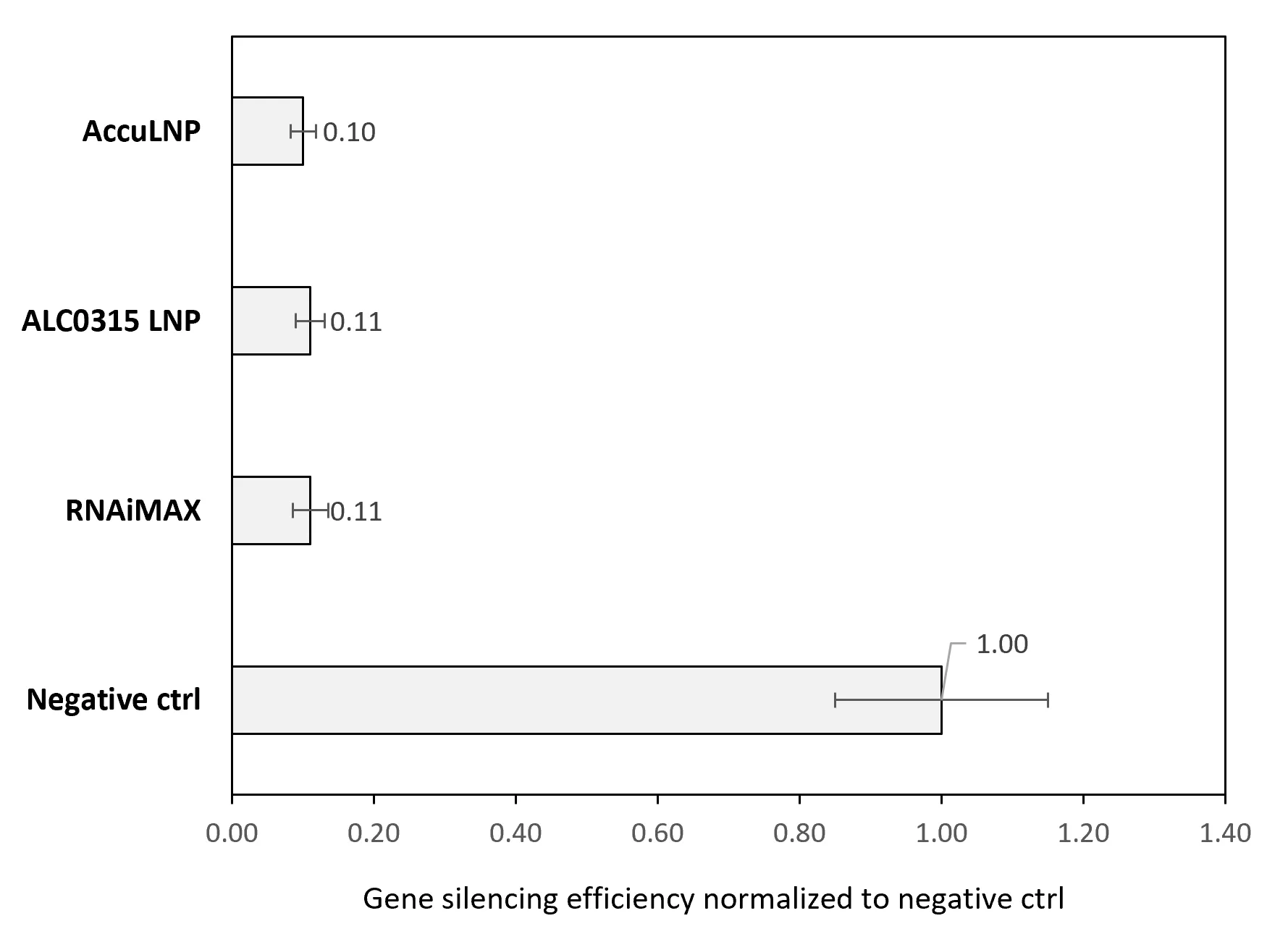
AccuLNP-siRNA is a cell transfection reagent mediated by lipid nanoparticles (LNP) for siRNA transfection. AccuLNP can efficiently interact with siRNA molecules to form (lipid molecules + siRNA) complexes and can effectively release siRNA molecules within cells to achieve their biological functions. This reagent has the characteristics of high transfection efficiency, low cytotoxicity, and easy operation.
Product Detail
| Catalog# | Name | Qty |
|---|---|---|
| NTP-0300-L | Reagent L (liquid) | 1 (250 µL) |
| NTP-0300-A | Reagent A (liquid) | 1 (250 µL) |
| NTP-0300-ST | Reagent ST (liquid) | 1 (10 mL) |
- Storage condition
- -20 °C
- Shelf life
- 12 months
- Encapsulation time
- ~60 s
- Cell viability
- >90%
- Format
- Three-reagent liquid kit — Reagent A, Reagent L, Reagent ST
Protocol
| For one well | 48-well plate | 24-well plate | 12-well plate | 6-well plate |
|---|---|---|---|---|
| Surface area | 1 cm² | 1.9 cm² | 3.8 cm² | 9.6 cm² |
| Complete growth medium (when plating cells) | 250 µL | 500 µL | 1 mL | 2.5 mL |
| siRNA (10 mM stock) | 2.5 pmol — 0.25 µL | 5 pmol — 0.5 µL | 10 pmol — 1 µL | 25 pmol — 2.5 µL |
| Reagent A | 1.625 µL | 3.25 µL | 6.5 µL | 16.25 µL |
| Reagent L | 0.625 µL | 1.25 µL | 2.5 µL | 6.25 µL |
| Reagent ST (to dilute transfection complex) | 25 µL | 50 µL | 100 µL | 250 µL |
The following procedure describes how to perform RNA transfections in a 24-well plate. The surface areas of other cell culture vessels are different, and transfection should be scaled accordingly. Follow Table 1 to appropriately increase or decrease the amount of reagent use.
-
Plate cells
-
Approximately 18–24 hours before transfection, plate cells in 0.5 mL complete growth cell culture medium per well in a 24-well culture plate. Ideally cells should be at least 70% confluent prior to transfection. For adherent cells, plate at a density of 0.8–3.0 × 10⁵ cells/mL; for suspension cells, 2.5–5.0 × 10⁵ cells/mL.
-
Incubate the cell culture overnight.
-
-
Prepare the transfection complex
-
Take the transfection kit out of the −20 °C freezer.
-
Thaw Reagent A and Reagent ST in a 37 °C water bath.
Note: Ensure Reagent A and Reagent ST are completely thawed and clear transparent solutions are obtained. Apply vortex mixing to the microfuge tubes of Reagent A and Reagent ST to ensure the solutions are homogeneous. Cool Reagent A and Reagent ST down to room temperature before use.
-
Thaw Reagent L in a 37 °C water bath for at least 10 minutes. Apply vortex mixing to the microfuge tube of Reagent L to ensure a homogeneous solution is obtained. Cool Reagent L down to room temperature before use.
-
Add 5 pmol (0.5 µL of 10 mM) siRNA stock solution in a sterile tube.
-
Add 3.25 µL Reagent A. Pipet gently to mix completely.
-
Add 1.25 µL Reagent L to the above diluted siRNA solution. Use a vortex mixer to mix quickly for at least 15 seconds. The resulting total volume is 5 µL.
-
Add 50 µL Reagent ST to dilute the above transfection complex. Pipet gently to mix completely.
-
-
Cell transfection
-
Add the transfection complex prepared in Step 2 (total 55 µL) dropwise to different areas of the well.
-
Gently shake the culture vessel to evenly distribute the transfection complexes.
-
Continue culturing in the cell culture incubator for the required time (such as 24 hours), and then the user determines the detection method to evaluate the transfection efficiency.
-
Notes
- Unused solutions of Reagent A, Reagent ST and Reagent L can be stored at −20 °C. Thaw and dissolve again in a 37 °C water bath before next use.
- The recommended siRNA stock solution to use is 10 mM. If the siRNA stock solution concentration is higher than 10 mM, dilute it with RNase-free water or appropriate buffer first to make sure the siRNA concentration is at 10 mM, and then proceed to prepare the transfection complex.
Ordering
Catalog number NTP-0300. Net 30 on an institutional purchase order. Prices exclude shipping and applicable tax. For scale-up, custom formats, or bulk pricing, email contact@genveyor.com.